How a Retired Bank Loan Officer Helped Me Find Hidden Money Leaks and Pay Off $38,000 in Credit Card Debt — Without Earning a Single Dollar More
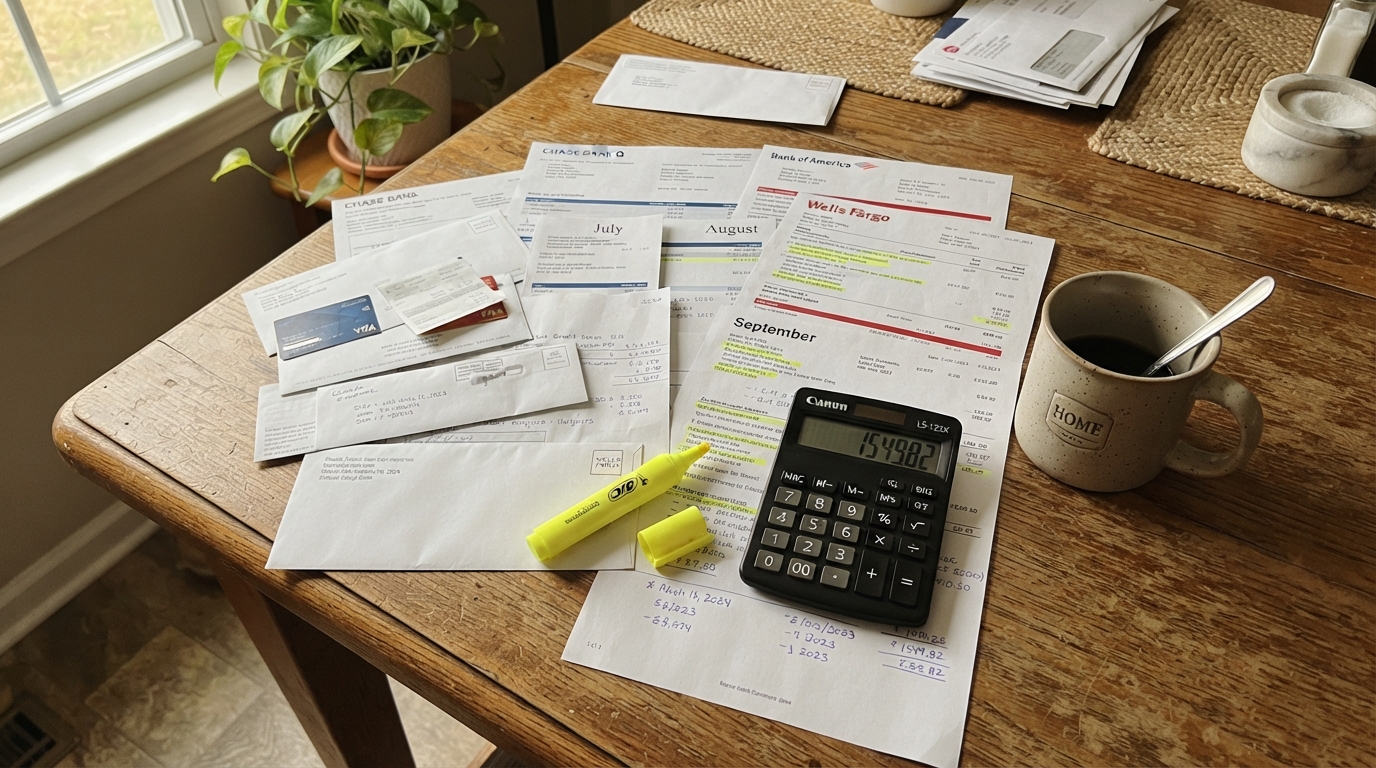
If your paycheck hits your account on Friday and by Tuesday you're already anxious about money — read every word on this page.
If you've sat down to figure out where your money went, added it all up, and still come out short — keep reading.
If you have credit card debt that you've been "working on" for two, three, maybe five years — and the balance barely moves — this is for you.
You're not broke. You're not bad with money. You're not irresponsible.
But something is wrong. And you feel it every single month.
The paycheck comes. The bills go out. There's a little left over. You promise yourself you'll put something toward the card this month. Something comes up — it always does. And somehow by the 20th, you're back on the card for gas or groceries or that thing you forgot about.
Where does it go? I make decent money. This doesn't make sense.
You've tried budgeting apps. You downloaded three. Used one for a week. Got tired of logging every coffee. Stopped.
You've made promises to yourself. January resolutions. Post-holiday fresh starts. Birthday-month clean slates. The intention is real. The follow-through dissolves by week three.
And the credit card balance just sits there. Minimum payments going out month after month, barely touching the principal while interest quietly keeps adding to it.
The worst part isn't the debt. The worst part is the feeling that you're running in place. That no matter what you do, you can't seem to get ahead. That your money is working against you and you can't figure out why.
Maybe I just need to make more money. Maybe I'm not cut out for this.
You are cut out for this. You just haven't been shown where to look.
"I know. Because I sat at that same kitchen table, with those same numbers, feeling that same quiet dread."

My name is Jaypee.
I'm not a financial planner. Not a certified credit counselor. I have no letters after my name.
I'm just someone who spent four years drowning in credit card debt — while earning what most people would consider a decent income — before I finally understood what was actually happening to my money.
At my worst, I had $38,000 spread across multiple cards. The kind of number that makes you feel like there's no way out.
I was making minimum payments on all three. Sometimes a little more than minimum. But the balances weren't moving in any meaningful way. I'd pay down $300, then need to put $250 back on the card two weeks later for something I "didn't plan for."
I told myself the problem was income. If I just made a bit more, I could throw a lump sum at this and be done.
I got a raise. The balances didn't really change. The lifestyle absorbed the extra money before I could direct it anywhere intentional.
I told myself the problem was discipline. So I tried a strict budget. Tracked every expense for three weeks. Found it exhausting and demoralizing. Quit.
I tried the debt snowball method I read about online — pay off smallest balance first, roll the payment to the next. Sensible. I got the smallest card paid off, felt great, then slowly started using it again within six months.
I tried automating a "debt payment" transfer at the start of every month. My checking account ran dry by the 25th and I had to transfer it back twice.
I went to see a credit counselor once. She was kind. She showed me a consolidation option that would save me interest. I didn't end up going through with it because the monthly payment was more than I felt comfortable committing to. I left feeling like I'd failed before I even started.
What nobody ever asked me — not the counselor, not the apps, not the budgeting guides — was a very simple question.
Where, exactly, is your money actually going?
Not the categories on a spreadsheet. Not what you think you spend. Not what you remember spending. The actual, specific, real dollar amounts disappearing from your account every single month — including the ones you've stopped noticing.
The person who finally asked me that question was a woman named Elaine.
Elaine is 71 years old. She spent 28 years working as a loan officer at a regional bank before she retired. She's my neighbor's mother-in-law, and I met her at a backyard barbecue in the summer of 2022.
I wasn't looking for financial advice that afternoon. I was just trying to eat a cheeseburger in peace. But somehow — the way conversations at summer cookouts go — we ended up talking about the cost of everything going up and how hard it felt to stay ahead. I made some offhand comment about my credit cards.
Elaine put down her drink and looked at me with the kind of calm, level look that only people who have seen a thousand loan applications develop.
"Can I ask you something?" she said. "Do you actually know where your money goes? Not roughly. Specifically."
I opened my mouth to say yes. And then closed it again.
Because the honest answer was: not really.
The Conversation That Changed Everything
We ended up talking for almost two hours. I sat there in a lawn chair while Elaine — methodically, patiently, without any judgment whatsoever — asked me questions I'd never thought to ask myself.
"Most people with debt don't have a spending problem," she said. "They have a visibility problem. The money is there. But it's leaking out through holes they can't see."
I'd never heard it described that way before. Leaking.
She explained what she'd seen over nearly three decades of reviewing people's finances for loan applications. Most people, she said, dramatically underestimate their recurring charges. Not their major bills — rent, utilities, car payment. Those they know. It's the smaller, automatic, invisible payments that compound into a serious drain.
Elaine — "You have subscriptions you forgot you signed up for. You have services renewing at prices that went up six months ago. You have accounts you haven't looked at in a year. You have payment patterns that made sense in a different situation and never got updated. Individually they seem small. Together they can be hundreds of dollars a month disappearing before you ever decide to spend it."
She called them credit leaks.
Your financial problem is probably not what you think it is.
Most people with persistent credit card debt assume the problem is that they don't earn enough, or they don't have enough discipline. So they try to solve it by earning more, or restricting more. And it doesn't work.
The real problem is that money is leaving your account in amounts you don't track, through channels you don't monitor, at prices you haven't reviewed in months or years. These are your credit leaks. Until you find them and stop them, any extra income or extra discipline just disappears into the same holes.
You don't have a spending problem. You have a visibility problem. And visibility is a solvable problem.
Elaine — "It is not that your money disappears. It is that you gave permission for it to leave — and then forgot you gave that permission. The bank didn't steal it. The landlord didn't steal it. You authorized it, and then you stopped watching."
I sat with that for a long moment.
I thought about the gym membership I'd barely used since February. The software subscription I'd signed up for during a free trial. The streaming services — how many did I have? I genuinely couldn't remember off the top of my head. The auto-ship on some supplements I kept meaning to cancel. The insurance policy I'd never shopped around on.
None of these were huge amounts. But I was starting to understand that wasn't the point.
"The method isn't complicated," Elaine said. "It takes less than an hour. You go through every single outgoing dollar from the last 90 days and you put each one through four simple questions. You'll find money you forgot you were spending. You stop or renegotiate those. You redirect that money to your highest-interest card first. You do not change your lifestyle. You just stop the leaks."
Elaine — "Don't try to do this halfway. Go through every line. And when you find money you didn't know you were losing — don't celebrate yet. First, redirect it. Then celebrate."
The First Week: Uncomfortable
I went home that evening and pulled up three months of bank statements and credit card statements side by side.
I'd never done that before. Not thoroughly. I'd glanced at statements. Checked balances. But I had never sat down and looked at every single line item across 90 days.
Day one: I felt defensive. Some of what I found, I immediately wanted to justify. That subscription is useful. I do use that. I need that.
Day two: I started being honest with myself. I found a software renewal I'd completely forgotten about — $96 for a year, just renewed last month, for something I hadn't opened in eight months.
Day three: I found a streaming service I was pretty sure I'd cancelled. Still going. $15.99 a month.
Day four: I called my internet provider and asked what other plans were available. I'd been on the same plan for four years. There was a current promotion that was $22 cheaper per month for the same speed. I switched in eleven minutes.
Day 5: The Number Started to Come Into Focus
By the end of the first week, I had found $340 a month in money I was spending without thinking, on things I either didn't need, had forgotten about, or could get cheaper without any sacrifice.
Not $340 I'd have to go without. $340 I was just... losing. Silently. Every month.
I kept going. By the end of my full 90-day audit, using the four-question framework Elaine had walked me through, I had identified $590 per month in credit leaks.
That is $7,080 per year. Going nowhere. Doing nothing for me.
Then Something Shifted Completely
I redirected that $590 to my highest-interest card first — the college-era card at 24.99% APR.
Within seven months, that card was gone. Not minimum-payment gone. Actually gone.
Then I rolled that payment to the next card. Then the next.
"The first month I didn't have a credit card payment due — I genuinely didn't know what to do with myself. I kept waiting to feel the anxiety. It didn't come."
Total time from that backyard conversation to zero credit card debt: 22 months.
My income didn't change. My lifestyle didn't dramatically change. I just stopped leaking money I didn't know I was losing.
After I paid off the last card, I kept getting asked by friends and coworkers how I did it. I told the story. I described the framework. But there's only so many times I can walk someone through it one-on-one.
So I documented everything. The exact process. The four questions. The sequence Elaine taught me. The specific order of operations for redirecting found money to debt most efficiently. The mistakes I made. What I'd do differently.
I turned it into a guide you can work through in a single sitting.
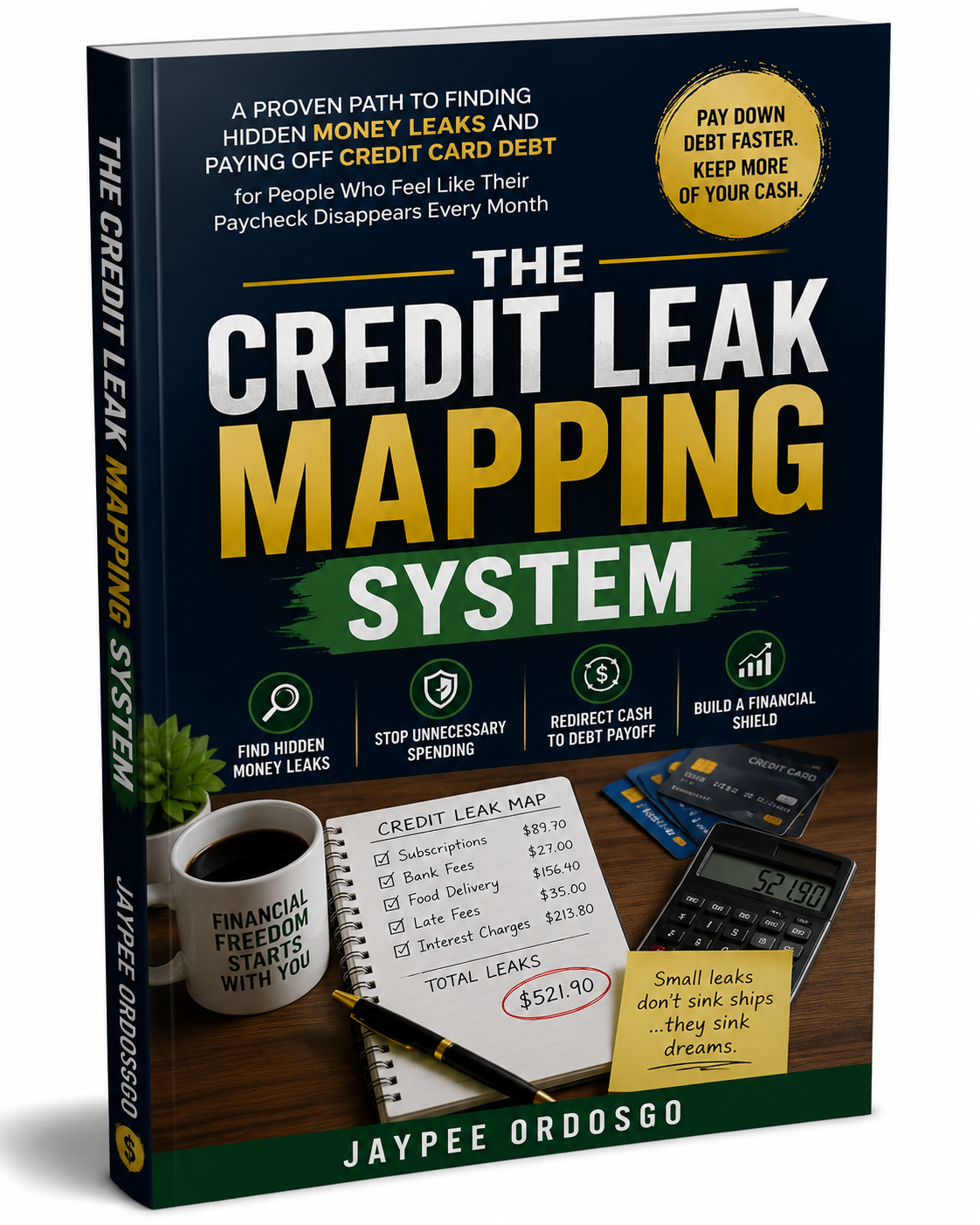
Everything Elaine taught me — written down, organized, and laid out so you can complete the full audit in one focused evening and know exactly where your money has been going.
Inside the guide, you'll find:
- The Credit Leak Map — a simple tool that shows every place your money quietly escapes each month, across 8 specific leak categories most people never think to check. You'll build yours using three months of real statements. (Chapter 3)
- The 8 Types of Credit Leaks — from forgotten subscriptions and bank fees to emotional spending, Buy Now Pay Later traps, and lifestyle drift. Most people are losing money through at least four of these right now. (Chapter 3)
- The Leak Priority Score — a simple 4-question scoring system that tells you exactly which leaks to fix first for the biggest payoff with the least disruption to your life. (Chapter 4)
- The Debt Strike Fund — the exact system for making sure every dollar you recover actually reaches your debt, instead of quietly disappearing back into your spending. (Chapter 5)
- The Debt Strike Formula — how to combine recovered leak money, windfalls, and unexpected income into a single focused debt payment each month. (Chapter 5)
- The Financial Shield — 7 practical rules (including the 24-Hour Pause Rule and the CLUE Check) that stop you from sliding back into debt once you've paid it off. (Chapter 6)
- Your First 30-Day Action Plan — a week-by-week breakdown of exactly what to do first, second, and third, so you leave this guide with a clear plan and not just good intentions. (Chapter 7)
- 7 Ready-to-Use Worksheets — including the Credit Leak Map, Leak Priority Scorecard, Debt Strike Tracker, Monthly Leak Audit checklist, and the CLUE Check card. Print them or use them digitally. (Resources section)
You don't need to earn more money. You don't need to go on a spending restriction that makes you miserable. You don't need an accountant or a financial planner.
You need to know where your money is going. This guide shows you how to find out — and what to do the moment you do.
"I was convinced my problem was that I didn't make enough. I went through the audit and found $410 a month in recurring charges I'd forgotten about or never bothered to cancel. I felt embarrassed, honestly. But mostly I felt like I finally had something real to work with. Fourteen months later the cards are at zero."
"The renegotiation scripts were worth the price alone. I called my internet provider using the exact language in the guide and got $28 off my monthly bill in a four-minute call. I'd been meaning to do that for two years and just never did because I didn't know what to say."
"We did the audit together as a couple, which I'd recommend. Things came up in the review that we'd each been embarrassed to bring up individually. We found $520 a month combined. We're down to one card now with a manageable balance. This thing works if you actually do the work."
"I was skeptical because I thought I already knew where my money went. I was wrong. Found $280 a month I genuinely hadn't tracked. The thing about the visibility problem rather than a spending problem — that reframe alone changed how I think about money."
"I've read a lot of personal finance content and most of it says the same five things. This was the first time someone gave me an actual process — not principles, an actual step-by-step thing I could sit down and do. I spent one evening on the audit and found $360 a month. Paid off the debt in 18 months."
Compare That to What You've Already Been Spending
How Much Does the Guide Cost?
I want to be transparent about what went into putting this together.
Between the time I spent documenting the process, working with a writer to make it clear and readable for someone starting from scratch, having the framework reviewed for accuracy, the design work on the guide itself, and the time invested in testing it with people in different financial situations — this was not a quick project.
- Writing and editing: $1,200
- Framework development and testing: $800
- Professional design layout: $400
- Technical review: $300
- Platform and hosting: $200
Total invested: over $2,900.
A fair price for this guide would be $97. That is still a fraction of what one session with a financial coach costs, and the guide doesn't expire after an hour.
But I know that if you're carrying credit card debt, spending $97 on a guide to fix the problem can feel like the wrong moment to spend money. So I priced it for access, not for what the market might bear.
Once You Click That Button, Here's What Happens
- You're taken to a secure checkout page. Takes about 60 seconds to complete.
- Your payment is confirmed and your guide is delivered immediately — to your email inbox, as a PDF you can open on any device.
- You set aside one evening, work through the audit using the guide, and by the end of that session you know exactly where your money is going and how much you can redirect toward your debt starting this month.
— This is me, Jaypee. As long as your payment goes through, access is immediate and guaranteed.
30-Day Money-Back Guarantee
Work through the guide. Do the 90-day statement audit. Apply the four-question filter to your outgoing payments. If after doing the actual work you genuinely believe this wasn't worth $17 — email me within 30 days and I'll refund you in full. No hoops. No "tell me why." No hard feelings.
I'm confident enough in this process to make that commitment, because I've watched it work — for myself and for others who did the work.
Right Now, You Have Two Choices
- The credit card balance stays where it is — or grows
- The money keeps disappearing without explanation
- Minimum payments keep going out month after month
- The anxiety before checking your balance continues
- A year from now, you're in the same place — or deeper
- You know exactly where your money is going — possibly for the first time
- You stop the leaks and redirect that money intentionally
- Your credit card balances start actually moving
- The low-grade financial anxiety starts to lift
- A year from now, you're measurably ahead
One last thing.
Picture yourself one evening from now — statements pulled up, audit done, a clear number in front of you. You know what's leaking. You know how much. You know exactly what to do with it.
Will you feel the relief of finally seeing the full picture?
Will you feel the strange satisfaction of cancelling the thing you forgot you were paying for?
Will you make the first real payment toward your debt — not minimum, not "a bit extra," but a deliberate, directed payment — knowing exactly where that money came from?
Now picture yourself one year from now if you close this page. Same balance. Same Friday anxiety. Same feeling that your money is working against you — and you still don't know why.
The difference between those two versions of you is a decision you make right now.
If you've read this far and you're still on the fence —
Ask yourself honestly: what is the cost of not doing this? Not in dollars. In months. In the ongoing quiet stress of a balance that won't move. In the feeling that you're working hard and getting nowhere.
$17 is not nothing. But it's also less than most people spend on things they don't think about twice. If this guide finds you even one forgotten subscription — which it almost certainly will — it has already paid for itself this month.
You've been waiting for something that actually works. This is concrete. Specific. Actionable. You can do it this week.
Stop waiting. Your future self is watching.
P.S. — This comes with a full 30-day money-back guarantee. Do the work. If you genuinely don't find it useful, email me and I'll refund you completely. You have nothing to lose by trying this.
P.P.S. — The $17 introductory price is for the first 100 copies. Once those are gone, the price returns to $47. I don't use fake countdown timers — when the introductory copies are gone, the price goes up, and that's that.
P.P.P.S. — Every month you don't do this audit is another month your money leaks away silently. The debt grows. The interest compounds. The opportunity to redirect that money shrinks. This is genuinely not something to sit on.
— Jaypee
Frequently Asked Questions
How is the guide delivered?
As a PDF, sent directly to the email address you provide at checkout. It arrives within seconds of your payment being confirmed. You can read it on your phone, laptop, tablet, or print it out — whatever works best for you.
How long does the audit actually take?
Most people complete the full 90-day audit in one focused sitting of 60–90 minutes. Some people break it into two sessions. You don't need any special software — just your bank and credit card statements (which you can pull up online) and the guide open beside you.
What if I've already tried budgeting and it didn't work?
Budgeting and leak-mapping are different things. Budgeting tells you how to allocate money going forward. Leak-mapping tells you where money has already been quietly leaving — the automatic charges, the forgotten renewals, the bills you've never renegotiated. Most people who have struggled with budgeting find the audit approach much more concrete and actionable, because it's backward-looking and specific rather than forward-looking and aspirational.
What if my debt is very large — $20,000, $30,000 or more?
The guide addresses this directly. The Credit Leak framework works regardless of total debt size, because it focuses on finding and redirecting money you already have — not on the total balance. The Redirect Sequence section is specifically designed for people with multiple cards and larger balances, and covers the order of operations for maximum interest savings.
Is the guarantee actually real?
Yes. Work through the guide, do the audit, apply the framework — and if you genuinely feel it wasn't worth $17, email me within 30 days and I will refund you. I don't ask for explanations. I don't make it difficult. I'd rather refund someone than have them feel they didn't get value. In practice, the people who do the work find the money, and the people who don't do the work don't ask for refunds — they just set the guide aside. Either way, you're not at risk here.
How is this different from the budgeting advice that's already free online?
Most free personal finance content covers the same general principles: spend less than you earn, build an emergency fund, invest early. That's all true and valuable. What it almost never gives you is a specific, repeatable process for identifying exactly where your money is currently going — not in broad categories, but line by line — and a concrete sequence for redirecting what you find. The Credit Leak Mapping System is a process document, not a principles document. It tells you what to do, in what order, with what specific questions to ask at each step.